From Pasuckuakohowog to Fox Tossing: Unusual and Brutal Sports Through History
Imagine a version of soccer where the field could be miles long and teams might have up to 1,000 players, and you have Pasuckuakohowog. This game, played by Native American tribes like the Algonquin, was a chaotic and rugged affair with very few rules. Players could kick, carry, and throw the ball toward goals that were often a half-mile apart. The intense matches were used not just for recreation but also to train warriors and settle tribal disputes, sometimes lasting for several days.
The Mesoamerican ballgame, originating with the Olmecs over 3,500 years ago, was a high-stakes sport with deep religious meaning. Players on I-shaped stone courts would strike a solid, heavy rubber ball, sometimes weighing up to nine pounds, using only their hips, thighs, or forearms. While the exact rules are not fully known, a later version of the game involved getting the ball through a high stone hoop, which would result in an automatic win. This was more than just a game; it was a ritual performance that could be used to resolve conflicts and, in some cases, ended with the sacrifice of the losing team to the gods.
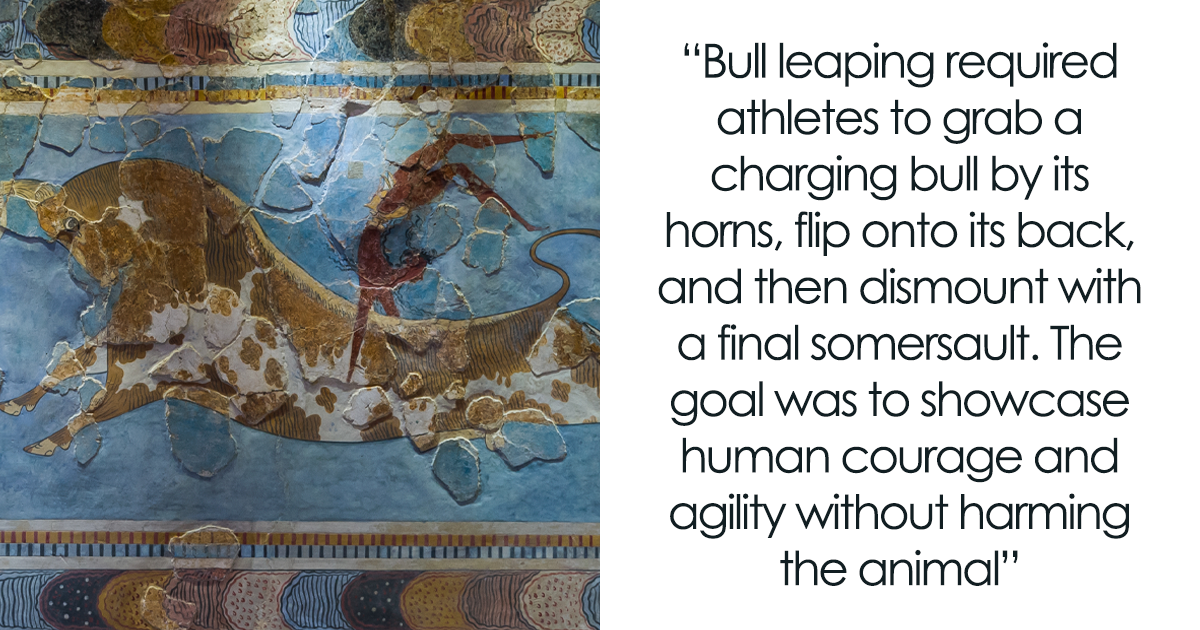
On the ancient island of Crete, the Minoans revered bulls not by fighting them, but by vaulting over them in a perilous sport known as bull leaping. This acrobatic ritual required athletes to grab a charging bull by its horns, use its momentum to flip onto its back, and then dismount with a final somersault. Unlike later bull sports, the goal was to showcase human courage and agility without harming the animal. Historians still debate whether these performers were high-status men proving their valor or a specialized class of athletes who trained for the spectacle.
In ancient Greece, Pankration was the ultimate "no-holds-barred" combat sport, essentially a wild blend of boxing and wrestling introduced to the Olympic Games in 648 BC. Competitors could punch, kick, and use grappling holds like chokes and joint locks, with the only real rules being a strict ban on biting and eye-gouging. A match only ended when one fighter surrendered (often by raising a finger to signal defeat) was knocked unconscious, or in some extreme cases, lost their life in the process.
Ancient Egyptian fishermen turned the Nile River into a competitive arena for a spontaneous and perilous game known as fisherman jousting. Two boats would approach each other, where the men would use their long punting poles as weapons to swipe at their rivals. The objective was simply to knock an opponent into the water, a victory that was especially dangerous since many of the fishermen never learned how to swim.
Gladiator contests were the blockbuster entertainment of ancient Rome, pitting highly trained combatants, who were often slaves or prisoners, against each other in massive arenas. These weren't just chaotic brawls; fighters specialized in distinct styles, such as the Retiarius with his net and trident or the heavily armed Secutor. Gladiators were expensive investments, and a crowd-pleasing performance could earn a defeated fighter mercy and the chance to fight another day.
Ancient Rome's idea of grand entertainment went far beyond the Colosseum with the creation of Naumachia, massive naval battles staged in flooded arenas. First organized on a spectacular scale by Julius Caesar, these events used thousands of prisoners of war as combatants and rowers aboard real warships. They would then fight, reenacting famous historical sea battles until one side's fleet was completely sunk for the crowd's amusement.
The Vikings transformed the simple game of tug of war into a lethal contest with a version that used animal hides instead of a rope. This brutal test of strength was held over a large pit of fire. The objective was horrifyingly straightforward, as the losing team was not just defeated but was dragged directly into the flames.
Dating back over 2,400 years to nomadic Turkic tribes, camel wrestling is a traditional spectator sport still popular in the Aegean region of Turkey. The event pits two male Tulu camels against each other, typically during mating season when their natural instinct to fight for dominance is highest. The camels use their powerful necks to push and wrestle until one is forced to retreat or fall to the ground. Victory is declared not through injury but by submission, making it a test of strength and will rather than a fight to the finish.
In ancient Mesopotamia, lion hunting was less a sport and more a royal performance of power for Babylonian and Assyrian kings. This highly symbolic event was designed to showcase the ruler's strength and his divine duty to protect civilization from the forces of chaos, which the lion represented. The hunts were often carefully orchestrated affairs where lions, captured beforehand, were released into a designated park or arena, allowing the king to slay them from a chariot or on foot in a grand public spectacle.
As one of Mongolia's "Three Manly Arts," the traditional wrestling style of Bökh is a pure test of strength where there are no weight classes, so a small competitor could be matched against a massive opponent. The goal is simple: force any part of your rival's upper body, knee, or elbow to touch the ground. Clad in a distinct open-chested vest and briefs, wrestlers perform a ritual "eagle dance" before grappling in matches that have no time limits and end only when one man is brought down.
With a history spanning thousands of years across multiple cultures, cockfighting turns natural rooster aggression into a brutal spectator event. The birds, specifically bred for their fighting instincts, are placed in a small ring known as a cockpit to battle. To ensure a more decisive and bloody outcome for gambling purposes, handlers often equip the roosters with sharp metal spurs, or gaffs, attached to their legs.
What looks like a mounted battle with wooden spears is actually a celebratory festival called Pasola on the Indonesian island of Sumba. This event, rooted in a local legend about a heartbroken husband, is held to honor the start of the rice planting season. The ritual combat continues until blood is spilled, a necessary sacrifice believed to satisfy the ancestors and ensure a bountiful harvest. Although in ancient times losing one's life in the game was considered a high honor, participants now use blunted spears, making the event far less dangerous.
Long before it became a roadside tourist spectacle, alligator wrestling was a cultural tradition for Florida's Seminole people. This daring practice involved capturing the powerful reptiles with their bare hands, serving as both a tribal celebration and a way to secure food. The sport's shift toward public entertainment reportedly began when a visitor on the Tamiami Trail paid a Seminole man for putting on a "great show," demonstrating how the risky custom evolved into a performance.
More than just a theatrical display for medieval nobility, jousting was a brutal sport with very real consequences, even for kings. In 1536, King Henry VIII was unhorsed and crushed by his own armored steed, leaving him with a festering leg wound and a suspected brain injury that may have triggered his infamous paranoia and tyranny. This wasn't an isolated incident, as the "sport of kings" also proved fatal for King Henry II of France, who perished after a lance splinter pierced his eye during a tournament.
The famous bridges of medieval Venice served as the battlegrounds for a uniquely brutal local tradition. Rival factions of working-class men would meet on a bridge and engage in a mass brawl with the sole purpose of throwing their opponents into the canal below. These stick-and-fist fights were so vicious, resulting in everything from knocked-out teeth to crippled legs, that they were proudly staged for visiting dignitaries. The spectacle prompted visiting French King Henry III to famously remark that it was "too small to be a real war and too cruel to be a game.”
Known among the Haudenosaunee people as the "Creator's Game," Tewaarathon was the original, sprawling ancestor of modern lacrosse. Vast teams, sometimes numbering in the hundreds or even thousands, would compete on fields that could stretch for several miles, with games lasting for days. More than just a sport, it was a sacred ritual used to settle tribal disputes and prepare young men for combat, earning it the nickname the "little brother of war" due to its intense and often violent nature.
In Afghanistan, the national sport of buzkashi is an intense and chaotic version of polo where the ball is replaced with a goat carcass. Before the match, the animal is decapitated and its limbs are removed, creating a heavy and awkward prize for the horsemen to fight over. This game is a fierce free-for-all, with each rider battling to seize the carcass, break away from the pack, and drop it in a designated scoring circle.
Beyond the famous gladiator duels, Roman arenas were also home to the Venatio, a spectacular and brutal form of public entertainment. In these staged hunts, a vast array of exotic animals, sourced from the furthest corners of the empire like lions, bears, and even elephants, were pitted against armed hunters known as venatores. The event was less a fair contest and more a one sided slaughter, designed to showcase Rome's dominion over the natural world and entertain the masses with bloody carnage.
Forget the one-on-one chivalry of jousting; the medieval melee tournament was a full-blown team brawl where two sides of armored knights clashed in a chaotic free-for-all. The primary objective was not necessarily to take a life but to capture opponents who could then be held for a profitable ransom. Even with blunted weapons, the sheer violence of the scrum meant that serious injuries and casualties were common, making it a lucrative yet perilous form of military training disguised as a sport.
A bizarre pastime popular among European aristocrats in the 17th and 18th centuries, fox tossing was a cruel form of entertainment